
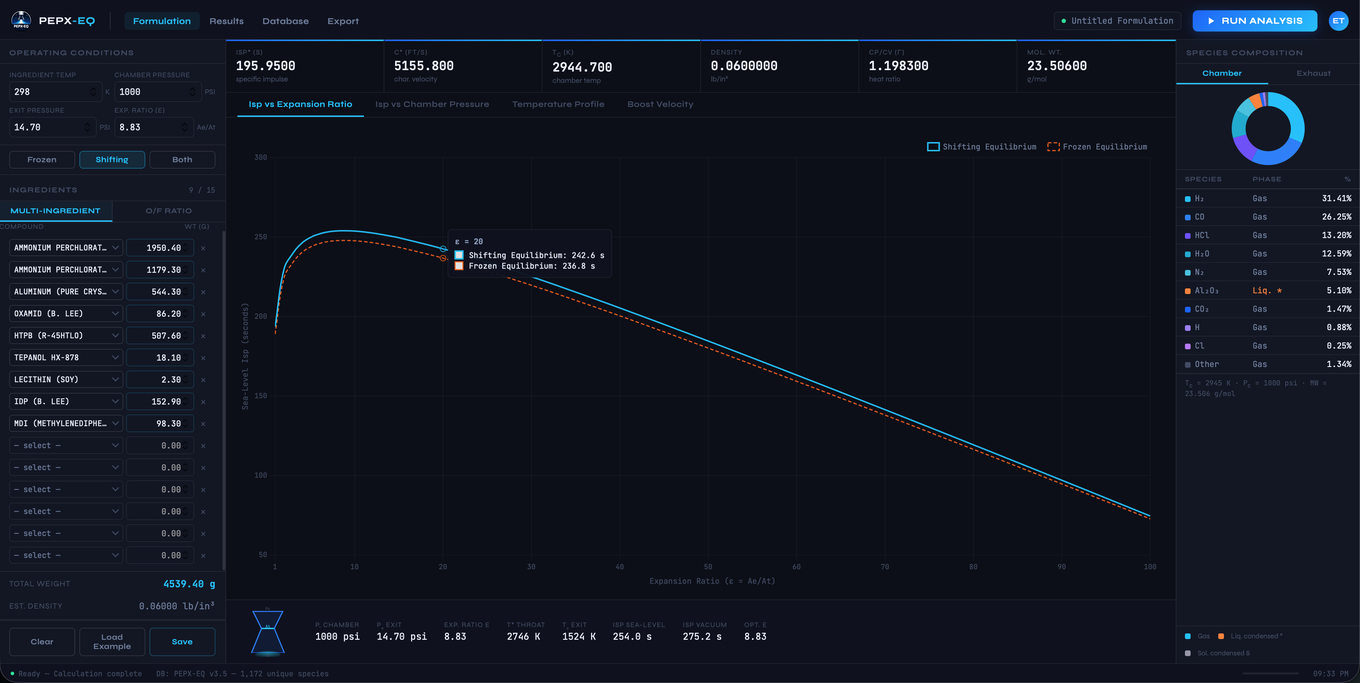
PEPX-EQ is a browser-based propellant analysis workstation built around a completely reconstructed thermochemical database. Unlike legacy tools, it runs entirely in the browser with a live ingredient editor supporting up to 15 components per formulation, drawn from a database of 1,172 validated species — covering everything from standard AP/HTPB composites to nano-energetic materials, exotic binders, and high-energy additives.
The underlying solver uses Gibbs free energy minimization to find the equilibrium combustion product species at the specified chamber conditions — computing both shifting equilibrium (products remain in equilibrium through the nozzle, the optimistic bound) and frozen equilibrium (composition freezes at the throat, the pessimistic bound) simultaneously, so the real delivered Isp always falls between the two curves.
Gibbs free energy minimization across 1,172 validated species. Supports shifting and frozen equilibrium simultaneously, with real-time product composition breakdown for both chamber and exhaust conditions.
Adiabatic flame temperature, molecular weight, heat capacity ratio, and full species composition with mole fractions — displayed as both a detailed table and an interactive donut chart for chamber and exhaust phases.
Ideal specific impulse (sea-level and vacuum), characteristic exhaust velocity (C*), and thrust coefficient (CF) for the specified expansion ratio and chamber pressure — directly comparable to static test data.
Full isentropic nozzle flow: throat and exit temperature, exit pressure, area ratio, optimal expansion ratio for a given ambient pressure. Computes the Isp vs. expansion ratio curve across the full ε range.
Four analysis views: Isp vs Expansion Ratio, Isp vs Chamber Pressure, Temperature Profile through the nozzle, and Boost Velocity. Shifting and frozen equilibrium plotted simultaneously on every chart.
Up to 15 ingredients per formulation from 1,172 species, with real-time weight tracking, estimated propellant density, and one-click example formulation loading. Export and save formulations directly.
| Parameter | Symbol | Units | Description |
|---|---|---|---|
| Adiabatic flame temperature | Tc | K | Combustion temperature at equilibrium for the given formulation and chamber pressure |
| Specific heat ratio | γ (k) | — | Ratio of specific heats of the combustion products — primary input to nozzle calculations (Module 10) |
| Molecular weight of products | M̄ | g/mol | Effective molecular weight of the product gas mixture |
| Characteristic velocity | C* | ft/s or m/s | Figure of merit for combustion efficiency, independent of nozzle design |
| Specific impulse (sea level) | Isp,sl | seconds | Ideal Isp at optimal expansion ratio for the specified ambient (sea-level) pressure |
| Specific impulse (vacuum) | Isp,vac | seconds | Ideal Isp in vacuum — upper bound, no ambient back-pressure penalty |
| Thrust coefficient | CF | — | Nozzle efficiency figure of merit (Module 10), used to compute thrust from chamber pressure and throat area |
| Optimal expansion ratio | εopt | — | Nozzle area ratio (Ae/At) that maximizes thrust for the given chamber and ambient pressures |
PEPX-EQ is the latest evolution in a lineage of propellant analysis tools stretching back to the 1960s. Understanding where it comes from explains why a ground-up rebuild matters.
The foundation of modern propellant analysis began at the Naval Weapons Center (NWC) in China Lake, California. As missile technology rapidly advanced, the Navy required a robust method to predict the performance of increasingly complex chemical formulations.
The result was the Propellant Evaluation Program (PEP), a FORTRAN-based solver designed to handle the minimization of Gibbs free energy for high-temperature systems. This original code established the gold standard for calculating specific impulse (Isp) and flame temperature, capable of processing up to 12 chemical elements and 200 combustion products simultaneously on the era's mainframes.
As computing moved from military mainframes to research labs, the Navy's code was ported by aerospace engineers at Martin Marietta (now Lockheed Martin).
ProPEP3 remained the state of the art for 12 years — until the development of PEPX-EQ, which marks the first time in six decades that the underlying database has been completely rebuilt from the ground up using 21st-century calorimetry.
The transition from ProPEP3 to PEPX-EQ represents a fundamental modernization of the underlying science. While legacy versions relied on aging data structures from the late 20th century, PEPX-EQ bridges historical reliability with 21st-century precision. This iteration was driven by the need for a high-fidelity, cross-platform engine capable of modeling modern hybrid systems, ALITEC formulations, and nano-energetic materials.
At the heart of PEPX-EQ is a completely reconstructed thermochemical database. Every entry has been cross-referenced against the latest validated research — including Fischer/Klapötke (2012) and Sinditskii (2015) bomb calorimetry — to eliminate the inconsistencies and nomenclature errors of legacy tools.
Expanded species and high-resolution materials:
PEPX-EQ is the practical implementation of several topics covered in the Technical Notes extended section. The nozzle flow calculations are rooted in Module 10 (Nozzle Design Theory). The Isp output is explained in Module 13 (Specific Impulse). The combustion efficiency concept (ηc) discussed in Module 13 is exactly what PEPX-EQ computes — and what static test data validates against.
The propellant formulation context lives in Module 07 (what PEPX-EQ is optimizing), and the motor design workflow — chamber pressure, Kn, casing loads — that uses PEPX-EQ's output lives in Modules 14 and 16.
PEPX-EQ is available to qualified researchers, motor developers, and engineering collaborators. Reach out to discuss access, integration, or collaborative development.