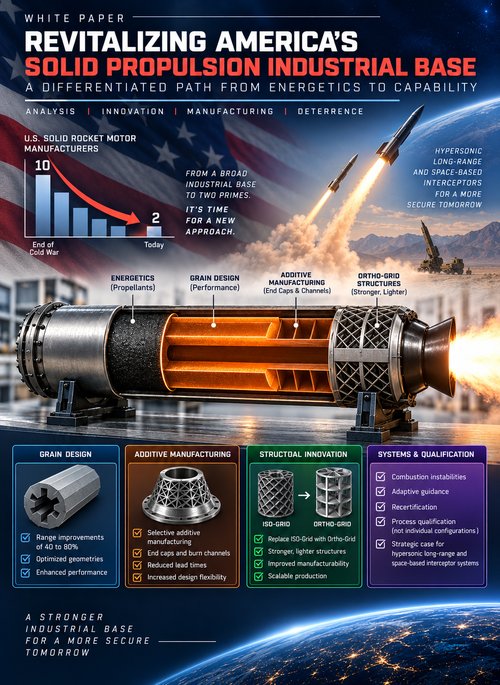
Solid rocket motors are the backbone of United States and allied missile capability and a cornerstone of space access. They are also, at this moment, in critical short supply. The industrial base that produces them has contracted from roughly ten independent companies at the end of the Cold War to two dominant primes today. That contraction, compounded by market segmentation between large-format strategic systems and tactical applications, has produced an industrial structure that is both brittle and inadequate to meet current and projected demand.
This paper argues that the solution is not to build a third version of what already exists. Entering the same supply chains with the same manufacturing processes, the same casting and milling infrastructure, and the same qualification frameworks will produce the same constraints. The path forward requires a fundamentally different approach: working from the energetics level upward; leveraging agile and additive manufacturing; rethinking grain and structural design assumptions that have been unchallenged since the 1990s; and qualifying manufacturing processes rather than individual configurations.
The technical opportunities are significant and concrete. Filling the hollow core void of center-perforated grain designs can yield 40 to 80 percent effective range improvements on tactical systems. Replacing ISO-Grid structural patterns with Ortho-Grid configurations cuts machining time by approximately half while producing lighter, stronger components. Selective application of metal additive manufacturing turns geometric complexity from a cost driver into an advantage. The strategic moment is real, and the country needs a broader, more resilient industrial base now, not at the end of a ten-year investment cycle.
Space became a war-fighting domain. The establishment of the United States Space Force marked the first formal addition of a new war-fighting domain in 100 years, since air was recognized as a distinct operational environment following World War I. The implications for propulsion, lift capacity, orbital maneuvering, and rapid response launch are only beginning to be fully understood and funded. At the same time, counter-unmanned aerial system requirements that did not exist five years ago are now urgent. The threat envelope is changing on timescales measured in months, not years, and the ability to reconfigure a motor's burn pattern in response to an emerging threat is not a luxury but a mission requirement.
At the end of the Cold War, approximately ten solid rocket motor companies operated in the United States. What followed over three decades was a textbook example of defense industry consolidation: mergers driven by reduced procurement volumes, acquisition of competitors to eliminate overcapacity, and the gradual concentration of capability into fewer and fewer hands. Northrop Grumman, through its acquisition of Orbital ATK in 2018, became the primary provider for large-format systems. L3Harris, through its acquisition of Aerojet Rocketdyne, controls the predominant share of tactical motor production. The result was not simply a reduction in the number of suppliers but a market segmentation that left large and tactical requirements in separate industrial silos, each served by a single dominant provider.
The answer to this problem is not to build a smaller version of what already exists. Consider the commercial drone industry as an instructive parallel. Drone companies emerged in large numbers, most of them convinced that they had a better approach than what already existed. Most of them failed. The failure pattern was consistent: they entered a market with established competitors, attempted to compete on the same parameters, drew on the same supply chains, and found themselves unable to differentiate on cost, performance, or schedule. Solid rocket motor manufacturing is a far more demanding environment for a me-too entrant. The way to succeed is not to compete on the existing terms. It is to change the terms.
The manufacturing philosophy that underlies a differentiated approach begins with a deceptively simple principle: work from the energetics level upward. Rather than integrating motors from purchased propellant, purchased casings, and contracted fabrication, the manufacturing model should encompass mixing and casting energetics in-house, testing on-site, and controlling the full production chain from raw materials through finished motor. This vertical integration is not about scale. It is about control, speed, and flexibility.
Rather than acres of dedicated casting and milling infrastructure, a compact, highly capable production environment using a blend of additive and subtractive manufacturing can build a wide range of configurations on the same production line. The production line is defined by capability, not by configuration. A development cycle measured in months, followed by a qualification cycle of two to four years, is dramatically faster than the traditional model where development itself can take years before qualification begins.
The center-perforated grain design has been the standard configuration for solid rocket motors for decades. The hollow core running through the center of the grain is volume not occupied by propellant. In a fixed motor envelope, that void is essentially wasted energetics capacity. Designing to fill that void increases the propellant mass fraction for a given motor envelope, translating directly to additional total impulse.
The range implications of this additional impulse are non-linear. A 10 to 20 percent increase in propellant mass can yield an effective range increase of 40 to 80 percent through the Tsiolkovsky rocket equation mass ratio effect. For a missile that currently reaches a target at 100 kilometers, this is the difference between a 100-kilometer weapon and a 140 to 180-kilometer weapon, with no change to the external form factor, no change to the launcher, and no change to the guidance system. If the grain geometry can be produced through additive manufacturing rather than fixed casting molds, modifying the burn profile for a different application becomes a matter of updating a CAD file, not designing new tooling.
A practical approximation in the industry holds that every seven pounds of excess mass on the booster costs one pound of spacecraft or payload capacity. The isogrid, the standard structural pattern machined into rocket fuselages since the 1990s, was not selected because it is the optimal structural topology. It was selected because the triangular cell geometry was the shape that the finite element analysis tools of the 1990s could solve most efficiently. The structural pattern was chosen to match the limitations of the analysis tools, not to optimize the structural performance.
Modern finite element solvers handle arbitrary geometries with equal reliability. When the isogrid pattern is re-evaluated using these tools, the result is an orthogrid, a pattern of rectangular cells in orthogonal rows and columns, which for most rocket structural applications yields a lighter and stronger result. The machining time required to produce an orthogrid is approximately half that required for an equivalent isogrid, because the orthogonal geometry allows the cutting tool to traverse the surface in straight passes. The 7000 series aluminum alloys can be hardened by room-temperature artificial aging without elevated-temperature annealing, and friction stir welding produces joints stronger than fusion welds without heat-affected zone degradation.
In additive processes, geometric complexity is essentially free. An end cap with integrated propellant retention features, complex pressure port geometry, and a smoothly curved closure surface is no more difficult to print than a simple hemispherical cap. Exotic alloys including Inconel and copper-based alloys that withstand 5,000 to 6,000 degrees Fahrenheit are well-suited to additive processes that build components without the tool wear constraints of subtractive machining. An unexpected advantage is that additively manufactured cooling channels produce better thermal management than their conventionally machined equivalents, because the surface roughness of the as-printed channel walls promotes boundary layer turbulence and higher heat transfer coefficients. The key discipline is selectivity: the manufacturing advantage goes to the engineer who knows where additive creates genuine advantage and applies it there.
American liquid rocket engine design has historically favored a fuel-rich combustion cycle. Soviet and Russian engine designers pioneered an alternative: the oxygen-rich staged combustion cycle, which burns essentially all of the fuel and extracts more chemical energy than a fuel-rich cycle, yielding a higher specific impulse. The cost is corrosion, requiring specialized coatings and material treatments. The RD-180, a Russian oxygen-rich staged combustion engine, entered American launch vehicles through the Atlas V program and demonstrated the performance advantages of this cycle architecture. The transition to domestically produced oxygen-rich engines, now underway at multiple American developers, represents both a technological inheritance and an independent capability.
Large liquid rocket engines operating at high chamber pressures are subject to a family of coupled fluid-structural-acoustic phenomena that can destroy the engine in seconds. Pogo is a longitudinal oscillation driven by acoustic resonance in the propellant feed lines. Buzz involves coupling of combustion dynamics with structural modes of the engine mount. Screech is a combustion-driven acoustic instability within the combustion chamber where local variations in energy release generate standing pressure waves that can melt through the chamber wall in one to two seconds. Screech suppression requires careful control of injector mixing patterns, operating pressure selection, baffles in the injector face plate, and effective fuel-based cooling, since fuel rather than oxidizer is always used for chamber cooling due to its superior heat transfer characteristics.
Rather than pre-loading a trajectory computed from forecast winds and checking whether actual winds are compatible with it, the wind field is measured from launch balloons and the trajectory parameters are updated to match the actual conditions. The updated flight software parameters are uploaded to the vehicle in under 60 seconds before planned ignition. This is made possible by parameterized flight software: the update changes constants within the code, not the base algorithms, which have already been certified through Hardware-in-the-Loop Simulation. Once flying, the flight control system can update its own trajectory parameters autonomously within the certified parameter envelope, continuously optimizing without ground intervention.
No system currently in the American inventory combines the range of the Tomahawk cruise missile with the speed of a hypersonic weapon. A system that achieved both would represent a qualitative change in standoff strike capability. At hypersonic speeds and Tomahawk-class range, a platform reaches a target over a thousand nautical miles away in a fraction of the time that any current subsonic standoff weapon requires. This requires solid propulsion for the boost phase, a storable liquid upper stage for the sustained cruise phase, and a guidance system capable of managing the combined flight profile. Systems must also survive 10 to 20 years of environmental storage and perform reliably on demand. A system designed for extended-range hypersonic strike can also be positioned in orbit for use as a space-based interceptor. Affordable mass is the critical technology lever: the performance parameters are achievable with current technology, but the constraint is cost, not physics.
The qualification framework that governs solid rocket motors was designed for fixed configurations and stable production volumes. In some programs, a change of a few millimeters triggers full system re-qualification. A more appropriate framework qualifies the manufacturing process rather than the individual configuration. Changes within the qualified design space do not require a new qualification, only verification that the change falls within the qualified envelope and that the manufacturing process has been applied correctly. This process-qualification approach is already used in pharmaceuticals and aviation. Applied to solid rocket motor manufacturing, it would reduce the cycle from requirement to certified production from years or decades to months.
The solid rocket motor industry exhibits "competimate" dynamics: it is not unusual for a company that competes against another in one segment to depend on that same company as a customer, supplier, or mission provider in another segment. What matters is maintaining the clarity to serve the national security mission as the primary objective. A new entrant with a genuinely differentiated technical approach does not simply add a third company to a market that already has two. It changes the competitive dynamics of the entire market, creating pressure on the existing primes to improve performance, reduce cost, and accelerate timelines that they currently have little competitive incentive to address.
The demand for solid propulsion is growing faster than the existing industrial structure can meet. The response to this juncture cannot be to build a slightly different version of what already exists. The path forward requires a genuinely novel approach: working from the energetics level upward, building agile manufacturing capability that does not depend on fixed large-scale infrastructure, rethinking grain design assumptions that have been unchallenged for decades, applying structural innovations that modern analytical tools make possible, using additive manufacturing selectively where it creates genuine advantage, and qualifying processes rather than individual configurations so that the industrial base can surge when demand requires it.
The technical foundations for this approach are solid. The manufacturing technologies exist. The propellant chemistry is understood. The structural analysis tools are mature. The guidance and control systems are capable. What is required is the conviction to apply them in a genuinely different way, and the support of investors and government partners who recognize that differentiation, not duplication, is what the country needs from this sector. The time is not the next decade. It is now.