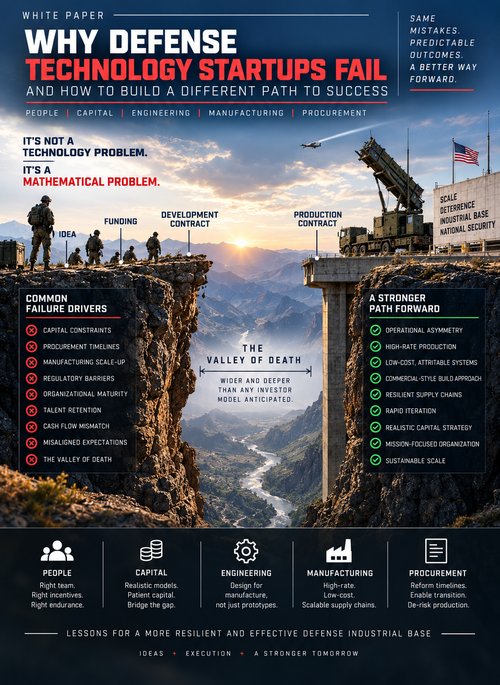
Defense technology startups are failing at a predictable rate and for predictable reasons. The failure pattern is not random. It is structural, and it repeats with enough consistency that it can be described as a playbook for destruction: raising capital to fund an engineering team against a government procurement timeline that was designed for established primes, burning through the runway before the production contract arrives, and discovering too late that the Valley of Death between development award and production award is wider and deeper than any investor model anticipated.
This paper is a practitioner's analysis of the specific engineering, capital, manufacturing, and organizational decisions that determine whether a defense hardware startup survives its first five years and scales to production, or becomes a cautionary case study. The central argument is this: the Western defense industrial base has a mathematical problem, not a technology problem. Near-peer adversaries hold manufacturing and production capacity advantages that cannot be closed by building better versions of legacy systems. The solution is operational and economic asymmetry, delivered through high-rate, low-cost, attritable systems produced by companies that build the way the commercial technology sector builds, not the way defense primes built in the 1980s. Getting that architecture right requires making a series of non-obvious decisions correctly, from the first day of the company through to the first rate production contract. This paper describes those decisions.
The defense startup failure rate is not primarily a product of insufficient engineering talent, inadequate capital, or lack of market demand. The problem is structural misalignment between how defense startups are organized and capitalized, and how the government actually buys things. The Valley of Death is the gap between technology demonstration, where SBIR grants and development contracts end, and production award, where multi-year, multi-hundred-million-dollar program funding begins. Most defense startups discover this gap between twelve and thirty months after their initial raise, when the runway is shortening and the production contract that was projected at twelve months is now projected at thirty-six.
The second structural failure mode is requirements creep. When a production contract slips and the engineering team needs to stay funded, the path of least resistance is to add capability to the prototype: additional military specifications, enhanced environmental testing, integration with additional platform architectures. Each addition is individually defensible and capable of generating near-term contract funding. Collectively, they destroy the unit economics that were supposed to make the platform competitive. A missile designed for a $50,000 unit cost that accumulates mil-spec requirements over three years may arrive at production with a $200,000 unit cost, at which point it is competing directly against incumbent prime products on cost and will lose.
The strategic context that defines the opportunity for defense startups is a manufacturing capacity asymmetry between the United States and near-peer adversaries that cannot be closed by conventional procurement. The correct optimization function is not parity. It is asymmetry: how to impose disproportionate costs on an adversary through systems that are dramatically cheaper to produce and deploy than the high-value targets they are designed to threaten or destroy. A low-cost attritable system that can reliably mission-kill a billion-dollar surface vessel does not need to win a fair fight. It needs to change the economic calculus of the fight entirely.
This framing has direct implications for engineering decisions inside defense startups. Cost and producibility are not secondary design considerations subordinate to performance. They are primary requirements, first-order constraints embedded in the design from the earliest concept phase. The production rate dimension is equally important. The ability to surge production in response to a rapidly evolving threat, to retool an assembly cell within two to three weeks to produce a countermeasure to an emerging adversary capability, is not a manufacturing efficiency metric. It is a strategic capability that belongs in the same conversation as range, accuracy, and lethality.
The capital strategy for a defense hardware startup must be designed around the reality of the procurement timeline. The first capital principle is to never depend on a single revenue stream. A startup entirely dependent on a government development contract has placed its survival in the hands of a procurement system that can slip by one to two years without consequences to the contracting officer. The startup, however, does not survive a two-year slip on a twelve-month runway. The antidote is establishing a commercial or B2B revenue stream that is not correlated with the primary platform program timeline.
The second capital principle is to minimize dilution during the development phase by maximizing non-dilutive government funding. SBIR and OTA agreements provide a pathway to sustained government investment that does not come with a cap table. A company that runs its development phase primarily on SBIR and OTA funding, with selective equity raises timed to manufacturing investment rather than engineering payroll, will have substantially more equity headroom when the production contract arrives. The third capital principle is that CapEx investment must precede the production contract. The government awards production contracts to companies that have demonstrated the ability to produce at volume. Pre-investing in manufacturing capacity using component revenue is not inefficient capital allocation. It is the price of admission to a production contract competition.
The business architecture that resolves the procurement timeline misalignment is a deliberate split between two revenue vectors that reinforce each other. The first vector is complete platform sales: end-to-end integration of a combat-capable system that the customer can operate without relying on additional integrators. The second vector is critical subsystem sales: the individual components that other defense companies need and cannot reliably source from the constrained domestic supply base. Platform sales capture the full margin of a complete weapons system and establish the startup as a capable prime contractor. Subsystem sales monetize that qualification effort across a broader customer base, generating revenue from components that would otherwise only serve the startup's own platforms, while also creating production volume that drives down unit costs on the platform side.
Traditional aerospace development attempts to simultaneously optimize mission performance, unit cost, and mass manufacturability from day one. This approach consistently fails in hardware startups because these three objectives are genuinely in tension at every stage of development. The block engineering method decouples them across distinct development phases, each with a clear primary objective and clear success criteria before transition to the next phase.
In the first block, the objective is to get hardware in the air as quickly as possible to validate basic flight dynamics. Hardware is built from solid billet stock using subtractive machining rather than from castings or injection molds, because a CNC toolpath change takes hours and a mold revision takes months. The propulsion system is sourced from proven hardware rather than from a developmental in-house design, because coupling an unproven airframe to an unproven powerplant creates a system where no individual failure can be isolated and attributed. In the second block, lessons are incorporated into a redesigned vehicle converging on mission performance. In the third block, the primary engineering objective shifts entirely to Design for Manufacturing. A redesign that reduces assembly touch time from fifty operator hours to zero operator hours through geometric design collapses unit cost in a way that no supply chain negotiation or labor efficiency program can replicate.
If a prototype crashes during flight due to an unhandled software exception, a power bus brownout, an actuator mechanical failure, or a sensor latency issue, the test was a ground process failure. Every subsystem integrated into a flight vehicle should have been characterized individually on a dedicated test bench before airframe integration. Flight campaigns must exist solely to gather aerodynamic, thermal, and ballistic data that cannot be simulated economically on the ground without multi-million-dollar, long-lead facilities. Actuator response, power system stability, flight software state machine transitions, sensor fusion behavior: these are ground test objectives. A flight vehicle should not be conducting its first full-system software integration test at altitude.
Building surplus test articles, producing ten vehicles for a five-test campaign, is not wasteful capital allocation. The cost of surplus test hardware is a fraction of the cost of an engineering team sitting idle for four weeks while replacement articles are fabricated after an avoidable attrition loss. The math consistently favors overbuilding test articles relative to the campaign requirement.
The vertical integration question is one of the most consequential capital allocation decisions a defense hardware startup makes, and it is consistently approached with the wrong framework. The question is not how much of the supply chain to control. The question is which specific elements create a strategic dependency that threatens rate, cost, or competitive position, and which elements are more efficiently addressed by the global commercial market.
The elements that merit vertical integration are those where the supply base is a monopolistic chokepoint with artificial price inflation or a structural constraint with multi-year lead times. The elements that should not be vertically integrated are those where the global commercial market has achieved a scale and cost position that no defense startup can replicate: silicon chips, multilayer printed circuit boards, standard optical imaging sensors, commodity structural materials. The strategic middle ground, the category that merits a hybrid approach, is where the most interesting decisions occur: components where commercial manufacturing processes are broadly available but proprietary integration creates competitive differentiation.
When a critical subsystem threatens to gate the entire program schedule, the conventional response is to allocate the best engineering resources to it and hope it resolves within the required timeline. The unconventional response, which consistently produces better outcomes at higher cost, is to run two independent competing development teams in parallel against the same requirement. If a single team has a fifty percent probability of meeting the schedule requirement, two independent teams each with a fifty percent probability produce a combined probability of seventy-five percent. In practice, the teams benchmark each other's progress, each receives additional motivation from the knowledge that the contract will go to the team that demonstrates the capability first, and the combined probability exceeds the independence assumption.
The discipline required to execute this approach is the willingness to terminate the losing team immediately and completely when one team demonstrates a validated capability. Continuing to fund both teams after the selection point fragments capital and engineering attention, creates organizational confusion about which design is authoritative, and delays the rate investment that the winning design requires. The transition from parallel development to focused execution must be immediate and complete.
The functional discipline matrix replaces program silos with a single pool of engineers organized by technical domain and assigned to specific program phases based on current program needs. A thermal engineer who completes the analysis for platform A's aft body transitions to the thermal architecture for platform B's propulsion bay without a hiring event or organizational restructure. Expertise accumulates across programs rather than in separate institutional silos. This requires that program phases be intentionally staggered so that the demand for specific functional expertise does not spike simultaneously across all platforms.
Communication complexity scales factorially with the number of people in a design team. A ten-to-fifteen-person design team that is aligned on the mission, empowered to make technical decisions without escalation, and working from a shared systems model will consistently outpace a fifty-person team navigating cross-functional alignment requirements. This is not a statement about engineering talent. It is a statement about communication architecture.
The manufacturing philosophy that enables high-rate, pivot-capable production maximizes the flexibility of the production infrastructure relative to its cost. In the defense context, the operational requirement changes on timescales of six to twenty-four months. A manufacturing facility built around specialized automation for the original design cannot accommodate these changes without a retooling investment that takes months and costs millions. A facility built around general-purpose five-axis CNC machining, flexible cellular assembly bays, and reconfigurable tooling can accommodate the same changes in weeks.
The capital discipline that enables this flexibility is the refusal to commit to hard tooling, injection molds, or dedicated casting before the aerodynamic closure of the platform design is confirmed. The design for manufacturing discipline, designing components for the capabilities of the specific manufacturing process rather than adapting the process to the design, is the single highest-leverage activity in reducing unit cost at production. The transformation of a multi-piece structural assembly into a unified self-fixturing geometry that requires zero hours of manual assembly labor does not happen through manufacturing efficiency programs. It happens through geometric design decisions made by mechanical engineers who understand the manufacturing process and treat producibility as a primary design constraint.
The first leadership discipline is the replacement of top-down deadline pressure with root-cause technical interrogation. What is the actual bottleneck? Is it a vendor lead time? A curing temperature that sets the pace of an energetics process? A harness routing decision that requires the airframe to be partially disassembled for each integration step? These are engineering problems with engineering solutions. They yield to collaborative technical analysis, not to top-down pressure. Engineers under arbitrary timeline pressure make design decisions that defer problems rather than solving them, producing fragile hardware and hidden technical debt.
The second discipline is the reservation of foundational strategic decisions for the executive leadership rather than for organizational consensus. Relocating the company to access a different engineering talent market, terminating a program that represents a significant fraction of current revenue, these decisions will be made incorrectly by popular vote because the popular vote optimizes for individual preferences rather than organizational survival. The third discipline is emotional inertia: dampening emotional responses to both the highs and the lows of hardware development. Hardware failures are expensive learning events. They are not organizational catastrophes unless the leadership responds to them as organizational catastrophes.
Building an unproducible science project is the most common and most catastrophic failure mode: a technology that is physically capable of meeting performance requirements but cannot be produced at volume by a semi-skilled workforce using commercially available materials and processes. The test that should be applied to every technology development decision is not whether it can be demonstrated, but whether it can be produced at high rate by operators who are not the engineers who designed it, using materials and processes available in the commercial market, at a unit cost that is competitive with the alternatives.
Premature hard tooling consistently produces an expensive redesign requirement when the aerodynamic closure it was based on turns out to be incorrect. Over-engineering the organizational process at startup scale consumes bandwidth that should be directed at solving technical problems, and it produces bureaucratic drag that slows the iteration cycle that is the startup's only competitive advantage over the incumbents. Treating vertical integration as a vanity metric rather than a strategic tool misallocates capital toward commodity components that the global commercial market already produces at unbeatable economics.
The decisions described above do not all have to be made at the same time. The correct sequencing is roughly correlated with the block engineering progression, with organizational and capital decisions leading the engineering decisions they enable. In months zero through three, the primary objective is foundational architecture and COTS proof of concept: block one airframe flight test using a commercial powerplant, validating flight dynamics and identifying primary technical risks before committing capital to proprietary subsystem development. In months four through eight, the objective is component independence and parallel subsystem development: standing up in-house propulsion or critical subsystem testing, initiating the block two airframe, launching parallel development teams on the highest-risk critical path item, and beginning component sales to generate non-correlated revenue. In months nine through twelve, the objective is platform convergence and B2B subsystem integration: integrating the block two platform with the proprietary powerplant, confirming the unit economics trajectory, and initiating pre-investment in scalable manufacturing capacity. In months thirteen through eighteen, the objective is rate tooling and Design for Manufacturing: releasing block three geometry with full DFM optimization, freezing hard tooling after aerodynamic closure confirmation, and transitioning the assembly floor to flexible cellular manufacturing.
The defense hardware startup that survives to production and builds a durable competitive position is not the one with the most advanced technology. The technology advantage is necessary but not sufficient, and it is also more temporary than the engineering team believes. The durable competitive position comes from the manufacturing capability, the organizational architecture, and the operational discipline that allows the company to iterate faster, produce cheaper, and pivot more quickly than any competitor can match.
The conventional defense procurement wisdom says that military specifications exist to ensure reliability, that long development timelines are inherent in the complexity of defense hardware, and that large integrated prime contractors are the appropriate delivery mechanism for complex weapon systems. The conventional venture capital wisdom says that the fastest path to revenue is the fastest path to value, that team size correlates with execution speed, and that vertical integration is a sign of ambition and strategic vision. Both are wrong in specific, predictable ways when applied to a defense hardware startup trying to build high-rate, low-cost attritable systems at venture speed. The company that internalizes these corrections and builds accordingly has a real probability of becoming the defense industrial infrastructure that the country needs and cannot currently buy from the incumbent base. The window for this is real. The window is not permanent.